implements the Grisu2 algorithm for binary to decimal floating-point conversion. More...
Classes | |
| struct | boundaries |
| struct | cached_power |
| struct | diyfp |
Functions | |
| template<typename Target , typename Source > | |
| Target | reinterpret_bits (const Source source) |
| template<typename FloatType > | |
| boundaries | compute_boundaries (FloatType value) |
| cached_power | get_cached_power_for_binary_exponent (int e) |
| int | find_largest_pow10 (const std::uint32_t n, std::uint32_t &pow10) |
| void | grisu2_round (char *buf, int len, std::uint64_t dist, std::uint64_t delta, std::uint64_t rest, std::uint64_t ten_k) |
| void | grisu2_digit_gen (char *buffer, int &length, int &decimal_exponent, diyfp M_minus, diyfp w, diyfp M_plus) |
| void | grisu2 (char *buf, int &len, int &decimal_exponent, diyfp m_minus, diyfp v, diyfp m_plus) |
| template<typename FloatType > | |
| void | grisu2 (char *buf, int &len, int &decimal_exponent, FloatType value) |
| JSON_HEDLEY_RETURNS_NON_NULL char * | append_exponent (char *buf, int e) |
| appends a decimal representation of e to buf | |
| JSON_HEDLEY_RETURNS_NON_NULL char * | format_buffer (char *buf, int len, int decimal_exponent, int min_exp, int max_exp) |
| prettify v = buf * 10^decimal_exponent | |
Variables | |
| constexpr int | kAlpha = -60 |
| constexpr int | kGamma = -32 |
Detailed Description
implements the Grisu2 algorithm for binary to decimal floating-point conversion.
This implementation is a slightly modified version of the reference implementation which may be obtained from http://florian.loitsch.com/publications (bench.tar.gz).
The code is distributed under the MIT license, Copyright (c) 2009 Florian Loitsch.
For a detailed description of the algorithm see:
[1] Loitsch, "Printing Floating-Point Numbers Quickly and Accurately with Integers", Proceedings of the ACM SIGPLAN 2010 Conference on Programming Language Design and Implementation, PLDI 2010 [2] Burger, Dybvig, "Printing Floating-Point Numbers Quickly and Accurately", Proceedings of the ACM SIGPLAN 1996 Conference on Programming Language Design and Implementation, PLDI 1996
Function Documentation
◆ append_exponent()
|
inlineprivate |
appends a decimal representation of e to buf
- Returns
- a pointer to the element following the exponent.
- Precondition
- -1000 < e < 1000
Definition at line 18548 of file json.hpp.
References JSON_ASSERT.
Referenced by format_buffer().

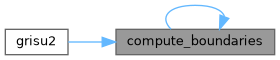
◆ compute_boundaries()
|
private |
Compute the (normalized) diyfp representing the input number 'value' and its boundaries.
- Precondition
- value must be finite and positive
Definition at line 17809 of file json.hpp.
References compute_boundaries(), diyfp::e, diyfp::f, and JSON_ASSERT.
Referenced by compute_boundaries(), and grisu2().

◆ find_largest_pow10()
|
inlineprivate |
For n != 0, returns k, such that pow10 := 10^(k-1) <= n < 10^k. For n == 0, returns 1 and sets pow10 := 1.
Definition at line 18112 of file json.hpp.
References find_largest_pow10().
Referenced by find_largest_pow10(), and grisu2_digit_gen().

◆ format_buffer()
|
inlineprivate |
prettify v = buf * 10^decimal_exponent
If v is in the range [10^min_exp, 10^max_exp) it will be printed in fixed-point notation. Otherwise it will be printed in exponential notation.
- Precondition
- min_exp < 0
- max_exp > 0
Definition at line 18600 of file json.hpp.
References append_exponent(), and JSON_ASSERT.

◆ get_cached_power_for_binary_exponent()
|
inlineprivate |
For a normalized diyfp w = f * 2^e, this function returns a (normalized) cached power-of-ten c = f_c * 2^e_c, such that the exponent of the product w * c satisfies (Definition 3.2 from [1])
alpha <= e_c + e + q <= gamma.
Definition at line 17948 of file json.hpp.
References cached_power::e, get_cached_power_for_binary_exponent(), JSON_ASSERT, kAlpha, and kGamma.
Referenced by get_cached_power_for_binary_exponent(), and grisu2().

◆ grisu2() [1/2]
|
inlineprivate |
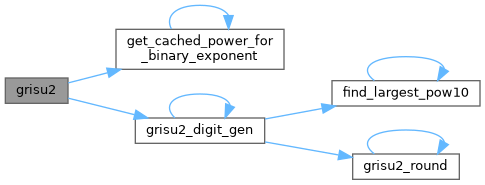
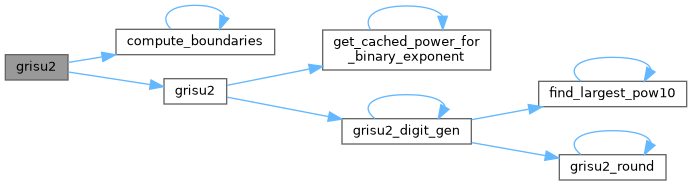
v = buf * 10^decimal_exponent len is the length of the buffer (number of decimal digits) The buffer must be large enough, i.e. >= max_digits10.
Definition at line 18448 of file json.hpp.
References diyfp::e, cached_power::e, diyfp::f, cached_power::f, get_cached_power_for_binary_exponent(), grisu2_digit_gen(), JSON_ASSERT, and cached_power::k.
Referenced by grisu2().

◆ grisu2() [2/2]
|
private |
v = buf * 10^decimal_exponent len is the length of the buffer (number of decimal digits) The buffer must be large enough, i.e. >= max_digits10.
Definition at line 18508 of file json.hpp.
References compute_boundaries(), grisu2(), JSON_ASSERT, boundaries::minus, boundaries::plus, and boundaries::w.
◆ grisu2_digit_gen()
|
inlineprivate |
Generates V = buffer * 10^decimal_exponent, such that M- <= V <= M+. M- and M+ must be normalized and share the same exponent -60 <= e <= -32.
Definition at line 18207 of file json.hpp.
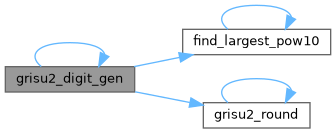
References diyfp::e, diyfp::f, find_largest_pow10(), grisu2_digit_gen(), grisu2_round(), JSON_ASSERT, kAlpha, and kGamma.
Referenced by grisu2(), and grisu2_digit_gen().

◆ grisu2_round()
|
inlineprivate |
Definition at line 18166 of file json.hpp.
References grisu2_round(), and JSON_ASSERT.
Referenced by grisu2_digit_gen(), and grisu2_round().

◆ reinterpret_bits()
|
private |
Definition at line 17668 of file json.hpp.
References reinterpret_bits().
Referenced by reinterpret_bits().
Variable Documentation
◆ kAlpha
|
constexprprivate |
Definition at line 17931 of file json.hpp.
Referenced by get_cached_power_for_binary_exponent(), and grisu2_digit_gen().
◆ kGamma
|
constexprprivate |
Definition at line 17932 of file json.hpp.
Referenced by get_cached_power_for_binary_exponent(), and grisu2_digit_gen().